
Designed as an accessible alternative to the Manley VOXBOX®, the DVC is built around an all-discrete transistor signal path. Each microphone preamplifier is coupled with a hand-wound Manley transformer, providing 50 dB of gain with rich harmonic content and exceptional transient response. The discrete topology ensures low noise and wide dynamic range across all input sources.
Langevin DVC - Dual Vocal Combo



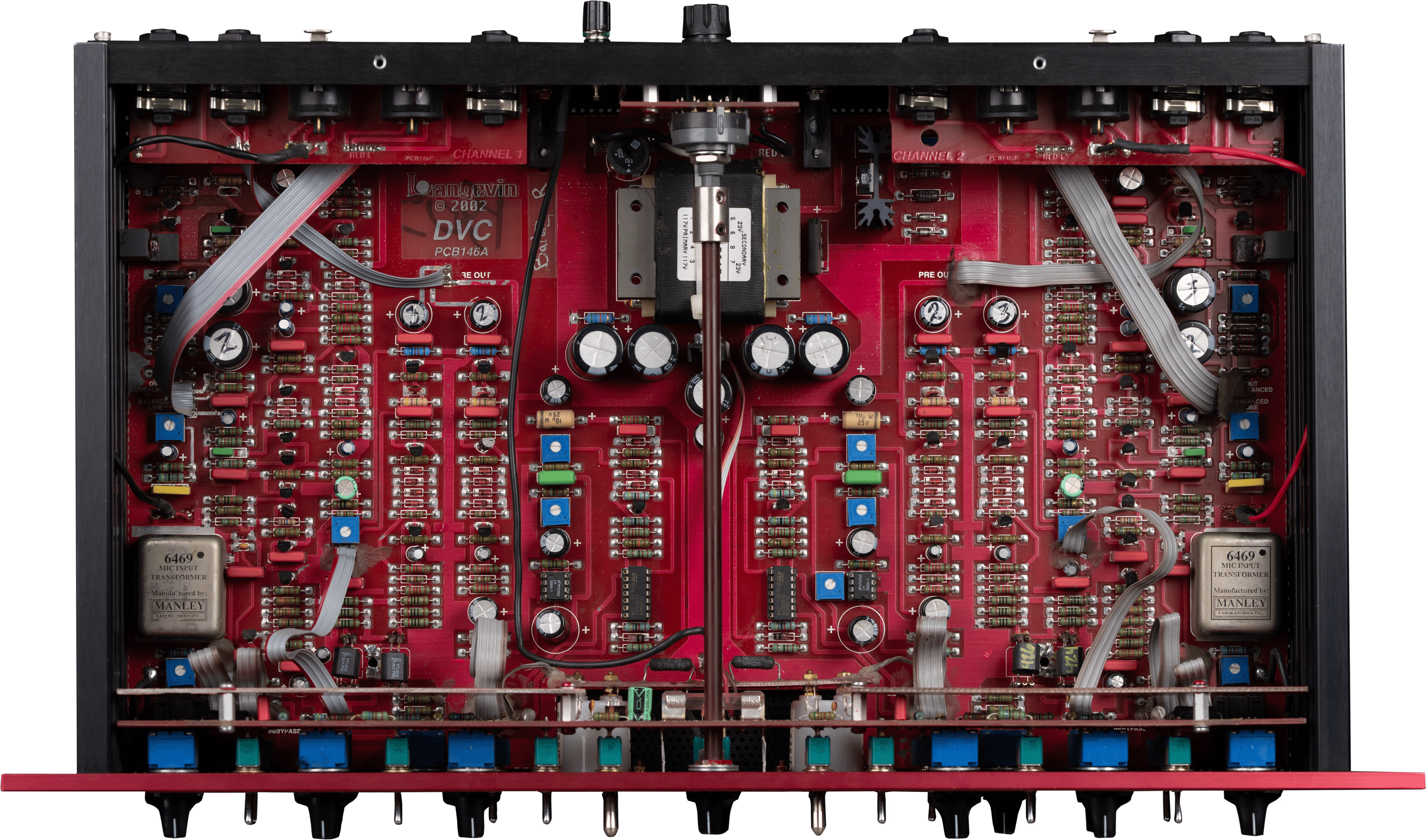




Langevin DVC - Dual Vocal Combo
Two channels of professional sound with essential workflow
- Dual-channel mic preamp with integrated shelving EQ and limiter
- All-discrete signal path with hand-wound Manley input transformers
- Musical dynamics control with electro-optical limiting stages
- Versatile channel strip architecture for tracking and mixing

Langevin DVC, two channels of discrete analog processing
The Langevin DVC (Dual Vocal Combo) is a dual-channel strip combining discrete microphone preamplification, passive shelving EQ, and electro-optical limiting in a streamlined 2U format. Featuring transformer-coupled inputs with hand-wound Manley transformers and an all-discrete transistor topology, the DVC delivers 50 dB of clean gain with defined midrange presence and natural clarity for professional recording applications.
Essential tone-shaping with passive shelving EQ
Each channel provides simple yet effective shelving equalization for low and high frequencies. The low shelf offers selectable corner frequencies at 40 Hz or 80 Hz, while the high shelf operates at 8 kHz or 12 kHz, allowing precise adjustments to add presence and weight to any source. The passive EQ can be completely bypassed for an uncolored signal path when transparency is required.
Flexible routing with electro-optical limiting
The DVC features two channels of electro-optical gain reduction derived from the acclaimed Manley ELOP® topology. This design provides smooth, transparent limiting with musical response characteristics ideal for vocals and instruments. Independent preamp/EQ and limiter sections allow operation as four discrete processing blocks, making the DVC equally effective for tracking and mix-bus applications.
Frequency Response
10 Hz – 20 kHz
THD+Noise
< 0.05% (preamp), < 0.04% (limiter)
Gain
38–53 dB (mic pre), -2 to +12 dB (limiter)
S/N Ratio
103 dB
Max Output
+31 dBv
Inputs
2x XLR Mic, 2x 1/4″ Hi-Z
Specifications
- Frequency Response: ±0 dB 10 Hz to 20 KHz
- <0.05% THD @ 1kHz
- S/N Ratio: 103dB
- Gain: 38 dB to 53 dB (adjustable)
- Mic Input Impedance: 2400 Ohm
- Mic Input XLR: BALANCED TRANSFORMER COUPLED
- DIRECT Input Impedance: 150K UNBALANCED 1/4"
- Output Impedance: 11 Ohm XLR; 6 Ohm 1/4" output
- Maximum Output: +31dBv (75 volts peak-to-peak)
- Input Sensitivity @ 1KHz (45 dB gain setting): 55 mV
- ALL-DISCRETE audio path
- Balanced XLR inputs & outputs
- Unbalanced 1/4" inputs & outputs
- Silent conductive plastic INPUT attenuators
- GAIN REDUCTION controls
- BYPASS switches
- Sifam VU METERS
- Meters switch to read OUTPUT or REDUCTION
- STEREO LINK switch
- <0.04% THD @1kHz
- Gain: -2 dB to 12 dB (adjustable)
- Unit is factory set for 100V, 120V or 220-240VAC operation for original destination country's mains voltage
- Operating Mains Voltage changeable with power transformer changeover switch and fuse value change
Frequently Asked Questions
The Langevin DVC was originally designed to provide a more affordable, simplified alternative to the all-tube Manley VOXBOX®. While both units are all-in-one channel strips, the DVC uses an all-discrete, solid-state signal path rather than vacuum tubes.
No, the Langevin DVC is not an all-tube unit.
The DVC is an incredibly versatile two-channel channel strip.
Yes, the Langevin DVC is designed with flexible I/O that allows you to use its different sections independently.
The EQ section on the DVC is designed to provide simple but effective tone shaping. It consists of passive high and low shelving EQs with selectable frequencies. This allows you to add or subtract body and "air" from a track without the complexity of a multi-band parametric EQ. The passive design is highly musical and transparent, and the EQ can be completely bypassed with a front-panel switch, ensuring a pristine signal when EQ is not required.
The "Main Out" on the DVC is the final output of the unit, located after the entire signal path (preamp, EQ, and limiter). It is a balanced, transformer-coupled output that provides a robust and harmonically rich signal. The "Direct Out" is located after the preamplifier section but before the limiter. It provides a clean, unbalanced signal that is ideal for sending to another destination or for parallel recording.
Couldn't find the answer you're looking for?
Check out our Help Center
